

Woman Questions Dog's Nose Boop Against Her Chest & It Saves Her Life
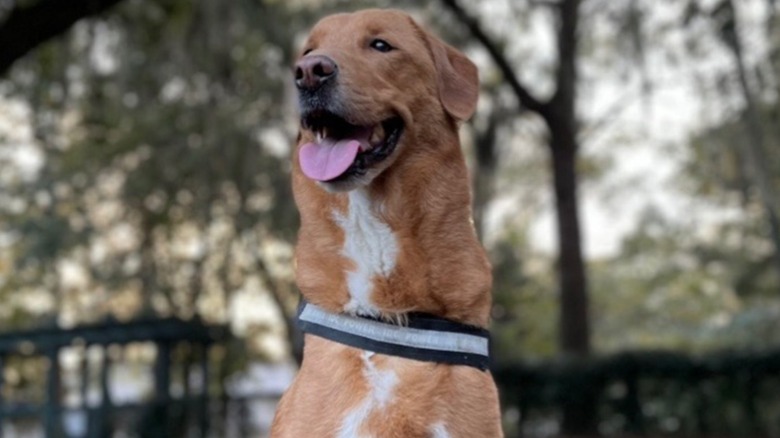
Dogs booping their noses at you or on your body can be a sign of affection, but for North Carolina resident Chase Johnson, that simple act led to a life-saving discovery in 2021 when her dog Cato took the concept of a super-boopable nose to a whole-new level. As explained in a Cleveland Clinic Instagram post from January 2026, Johnson had noticed her Labrador retriever mix, Cato, actively nervously. Cato was following her around the house and pacing the room, whining. Then, one day, he pressed his snout firmly against her left breast.
Johnson told The Mirror US that she visited her primary care doctor for a mammogram after Cato's alert. That led to a biopsy and diagnosis of triple-negative breast cancer, an aggressive form of breast cancer that affects 13 in every 100,000 women and moves very fast (via Cleveland Clinic). She started treatment soon after that. Johnson went through chemotherapy, surgery, and radiation treatment, and she's now cancer-free. Interestingly, this may not have been a first case of its kind, as dogs have been known to have that ability to sense cancer and other diseases.
How a dog became a lifesaver

According to the National Breast Cancer Foundation, a tumor can grow by 1% each day, meaning early diagnosis and treatment is important. That's why Cato's nose boop was so life-saving. And it's not the first time this dog became a super-sniffer for cancer, either. As it turns out, Cato had previously alerted her husband, Ben Byrn, in a similar way. The dog started acting anxious and following him around, behavior that eventually led to a colon cancer diagnosis for Byrn.
Had it not been for Cato's behavior and her prompt doctor follow-up, neither Chase Johnson nor Ben Byrn may have survived. It's further proof that dogs' sense of smell is so impressive. After all, researchers suspect that dogs can smell many things that humans can't, like pregnancy and stress.
Can dogs really smell cancer, though? Research published by the American Veterinary Medical Association indicates that dogs, both trained and untrained, may be able to detect the disease. However, it's not that clear cut. More research is needed to explore training and the extent of dogs' cancer-sniffing skills, but researchers generally believe that dogs could play a role in early cancer detection in the future.
Cato's nose boop has helped shape scientific research
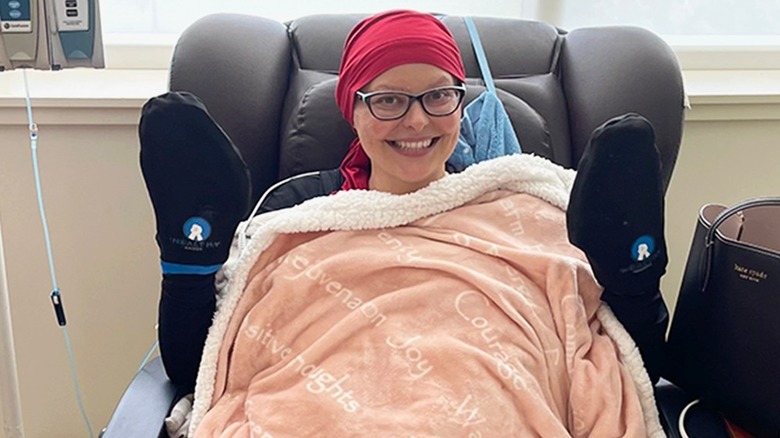
Eventually, Chase Johnson enrolled in a small clinical study that showed promising results in its first phase. The Cleveland Clinic Research Institute trial is the first-ever designed to target a specific protein common in triple-negative breast cancer, and she was one of 35 people enrolled in the early research.
The Phase I clinical research found that an investigational vaccine for triple-negative breast cancer is safe and well-tolerated. In fact, it produced a favorable immune response in 74% of study participants, according to a December 2025 press release from Cleveland Clinic. The next research phase is slated to begin by the end of 2026 and is aimed at determining whether the vaccine can help prevent this aggressive breast cancer from recurring.
Now cancer-free for a handful of years, Johnson is using her story and Cato's nose boop to raise awareness. "I'm grateful for every day and for the chance to be part of something that could change lives," she shared with the Cleveland Clinic in its January 2026 Instagram post. "If this work helps even one person avoid what I went through, it's worth everything."